Iliad
Ancient Greek epic poem attributed to Homer, central to classical philology.

The Iliad is one of two major surviving ancient Greek epic poems attributed to Homer. It is one of the oldest extant works of literature still widely read by modern readers and is often regarded as the first substantial piece of European literature. The poem is set towards the end of the Trojan War, a 10-year siege of the city of Troy by a coalition of Mycenaean Greek states, and depicts significant events in the war's final weeks, particularly the anger of Achilles.
- type
- Epic poem
- language
- Homeric Greek (literary mixture of Ionic Greek and other dialects)
- attributed_author
- Homer
- composition_date
- Around the 8th century BC (some scholars argue for mid-7th-century BC)
- number_of_books
- 24
- meter
- Dactylic hexameter
Lore & Background
The poem begins with an invocation to the Muse. After nine years of fighting, the Achaeans had sacked towns allied with Troy and captured two maidens, Chryseis and Briseis. Agamemnon took Chryseis; Achilles took Briseis. When Agamemnon refused to return Chryseis to her father, a priest of Apollo, Apollo inflicted a plague. Under pressure, Agamemnon agreed to return Chryseis but took Briseis from Achilles. Achilles furiously withdrew from battle and prayed to his mother Thetis to ask Zeus to make the Achaeans suffer. The rest of the poem follows the consequences of this quarrel, including duels, divine interventions, and the eventual death of Hector.
Reader's Guide
The Iliad is widely esteemed by the ancient Greeks and formed part of their standard education. Its conflation of different regional dialects and its depiction of various Greek factions uniting to fight Troy gave it strong resonance across the Hellenistic world. It was performed by professional reciters known as rhapsodes at Greek festivals such as the Panathenaia. Critical themes include kleos (glory), pride, fate, and wrath. Despite being predominantly known for its tragic and serious themes, the poem also contains instances of comedy and humor. It is frequently described as a heroic epic, centered around war, violence, and the heroic code. The poem contains detailed descriptions of ancient warfare, including battle tactics and equipment, and also explores social and domestic aspects of ancient culture. The Olympian gods play a major role, aiding their favored warriors and intervening in personal disputes. The poem's formulae, use of similes, and epithets are often explored by scholars. The Iliad remains central to the study of classical philology and is one of the oldest extant works of literature still widely read by modern readers.
Did You Know?
- The poem does not depict the fall of Troy nor mention the Trojan Horse.
- It was performed by professional reciters known as rhapsodes at Greek festivals such as the Panathenaia.
- The poem's composition, historicity, and authorship are extensively debated, known as the Homeric Question.
Oral Origins and the Bardic Tradition
The Iliad, like other primary epics, emerged from a world before writing existed. Bards composed these vast narratives using intricate rhetorical and metrical schemes that allowed them to memorize the tradition as received and then embellish it during live performances. Milman Parry and Albert Lord, working in the early twentieth century with living oral traditions in the Balkans, demonstrated that such epics are built from short, self-contained episodes of roughly equal weight. This paratactic structure made it possible for a performer to recall one episode after another and reconstruct the entire poem in real time. Parry and Lord further argued that the most probable route by which the Homeric poems reached written form was simple dictation from an oral performance. In this sense, the Iliad is not a text that was first written and then spoken, but a spoken work that was later captured in writing. The poem belongs to a broader oral tradition in which poetry was transmitted purely by voice, from performer to performer and to audiences, alongside written scriptures as a means of spreading culture.
Structure and Conventions of the Form
The Iliad embodies the formal conventions that scholars and critics have long associated with epic poetry. Aristotle, in his Poetics, placed the epic alongside tragedy as an imitation in verse of elevated characters, distinguishing it by its single meter, its narrative form, and its freedom from the time constraints that bind dramatic action. Later critics such as Harmon and Holman codified ten hallmarks of the genre, many of which the Iliad displays: it plunges the reader directly into the action, sets its story across a vast landscape, opens with an invocation to a muse, states its theme early, deploys recurring epithets, includes sweeping catalogues of warriors and ships, features extended formal speeches, and shows gods intervening directly in human affairs. The poem also centers on heroes who embody the highest ideals of their culture. In Ancient Greek, the very word for epic, epikos, originally encompassed all poetry in dactylic hexameter, including the wisdom verses of Hesiod and the oracle utterances at Delphi. It was later tradition that narrowed the term to the heroic narrative form the Iliad exemplifies.
Legacy and Influence on Western Letters
The Iliad stands as one of the foundational texts that shaped the entire Western literary tradition. Nearly every major work of Western epic poetry, from Virgil's Aeneid to Dante's Divine Comedy to Milton's Paradise Lost, consciously presents itself as a continuation of the tradition inaugurated by Homer. Later writers such as Apollonius of Rhodes, Camões, and others adopted and adapted the Homeric style and subject matter, though they employed literary devices available only to those who work in writing rather than in oral performance. The cultural footprint of the Iliad extends far beyond poetry. The genre it helped define gave English the adjective "epic" and inspired derivative works in other mediums, including epic films that seek to evoke or emulate the grandeur and scope of the original poems. The Iliad and its companion, the Odyssey, are routinely cited alongside Virgil's Aeneid and the anonymous Beowulf as the epics that most profoundly shaped Western literature and culture.
Scale and Place Among World Epics
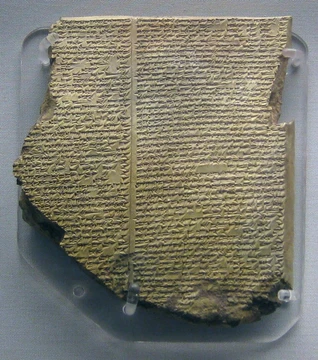
The Iliad occupies a distinctive position in the global landscape of epic poetry. It is neither the oldest nor the longest of the great epics. The Epic of Gilgamesh, recorded in ancient Sumer between roughly 2500 and 1300 BCE, predates it and is recognized as the oldest known epic. The Indian Mahabharata, composed between the third century BCE and the third century CE, dwarfs the Iliad in sheer volume: at approximately 1.8 million words, it is roughly ten times the combined length of the Iliad and the Odyssey. The Persian Shahnameh is about twice the Mahabharata's length, and the Rāmāyaṇa is roughly a quarter of it. Yet the Iliad's influence is disproportionate to its size. It appears in virtually every survey of famous epics, listed alongside the Sumerian Gilgamesh, the Sanskrit Mahabharata and Rāmāyaṇa, the Finnish Kalevala, the German Nibelungenlied, the French Song of Roland, and modern works like Derek Walcott's Omeros. Its compact power has made it a touchstone for the genre across cultures and centuries.
More in Poetry Collections And Epic Poems 1-22
Spotted an error? Know more?
This is a living reference — every entry is fact-audited, and reader corrections feed straight into our audit queue. Suggest an edit · See this site's audit record